
|
|
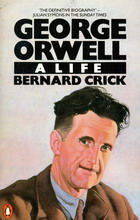
George Orwell: A Life
Crick, Bernard
Publisher: Penguin, United KingdomYear Published: 1980 Pages: 656pp Price: $9.95 ISBN: 0-14-00-5856-7 Resource Type: Book A biography of George Orwell. Abstract: Looking at both the private life of Eric Blair and his public character of George Orwell, Bernard Crick constructs a life of the political writer. There is detailed commentary on how his work was received during his lifetime, and the book ends with his death shortly after the writing of Nineteen Eighty-Four. His writing is analyzed not only for its political implications, but also for its origins in Orwell's life. There is a good deal of focus on his childhood and the formation of his world vision. Spanning 17 chapters, this book goes over Orwell's entire life from his own personal papers and journals. All of his essays, novels, descriptive works, poems and newspaper columns are referenced for their places in his life. Even his childhood letters home from preparatory school were included in preparing the volume. The Appendices include rough notes for Nineteen Eighty-Four and a speculation as to the date of "Such, Such were the Joys". Located in the middle of the book is a collection of photographs of Orwell and family. Orwell and his contemporaries are quoted extensively to provide context and a first-hand account. Remembered for his political ideologies of socialism and social responsibility, this biography attempts to also remember him as a person and to make connections between the life and the work. Orwell is shown to be a man who grew up fearing totalitarianism, poverty and supression. He believed that equality was not the same as liberty, nor was nationalism the same as patriotism. The ideas expressed in his numerous works were a result of the personal experiences that are here recounted. [Abstract by Mia Manns] Table of Contents List of Illustrations Acknowledgements Introduction 1 "And I was a chubby boy" 2 The joys of prep school and the echoing green 3 Learning and holidays 4 Eton: Resting on the oars (1917-21) 5 An Englishman in Burma (1922-7) 6 Going native in London and Paris (1928-31) 7 Hard times or struggling up (1932-4) 8 Bookshop days (1934-5) 9 The crucial journey to Wigan Pier and home to Wallington (1936) 10 Spain and "necessary murder" (1937) 11 Coming up for air (1938-9): the political writer 12 The challenge and frustration of war (1939-41) 13 Broadcasting days (1941-3) 14 Tribune and the making of Animal Farm (194355) 15 Famous and solitary man (1945-6) 16 Jura days 17 The last days and Nineteen Eighty-Four Appendix A Appendix B Notes Index Excerpts: "I see that it is invariably where I lacked a political purpose that I wrote lifeless books and was betrayed into purple passages, sentences without meaning, decorative adjectives and humbug generally." Orwell came to see himself as a 'political writer', and both words were of equal weight. He did not claim to be a political philosopher, nor simply a political polemicist: he was a writer, a general writer, author of novels, descriptive works, that I will call 'documentaries", essays, poems and innumerable book reviews and newspaper columns. But if his best work was not always directly political, it always exhibited political consciousness. His greatest influence has been posthumous and has been for liberty and tolerance, but not as passive things to be enjoyed, rather as republican virtues to be exercised: the duty of speaking out boldly ('the secret of liberty', said Pericles, 'is courage') and of tolerating rival opinions not out of indifference, but out of principle and because of their seriousness. "There is now a widespread idea that nostalgic feelings about the past are inherently vicious. One ought apparently to live in a continuous present, a minute-to-minute cancellation of memory, and if one thinks of the past at all it should merely be in order to thank God that we are so much better than we used to be." Orwell was careful... to distinguish between patriotism, as love of one's own native land... and nationalism, as a claim to natural superiority over others. His pictures of the white man have a contempt mingled with pity. On the other hand the Burmese are not pictured as saints. Orwell is in fact not the usual minority man who turns against the British Empire and who makes heroes of the oppressed simply because they are oppressed. Orwell is far subtler and far more honest than that. He is really an active moralist, a preacher who sees that oppression creates hypocrisy, and that hypocrisy corrupts. "Marxists as a rule are not very good at reading the minds of their adversaries." Probably he had picked up most of what he knew from the 'oral tradition" (like so many students in the 1960s), by meeting Marxists and listening attentively and seriously as they argued. "The basic trouble with all orthodox Marxists is that, possessing a system which appears to explain everything, they never bother to discover what is going on inside other people's heads. That is why in every western country, during the last dozen years, they have played straight into the hands of their adversaries." "Whereas Socialism, and even capitalism in a more grudging way, have said to people 'I offer you a good time', Hitler has said to them, I offer you struggle, danger and death, and as a result a whole nation flings itself at his feet." "If you look into your own mind, which are you, Don Quixote or Sancho Panza? Almost certainly you are both. There is one part of you that wishes to be a hero or a saint, but another part of you is a little fat man who sees very clearly the advantages of staying alive with a whole skin. He is your unofficial self, the voice of the belly protesting against the soul." Inwardly a solitary man, Orwell had always liked company at times of his own choosing. Reserved or inhibited about his real feelings as he was, even with intimate friends, yet he liked to spend part of the day hearing good talk about books and politics -- without, of course, seriously disrupting his work timetable. Lunches were the solution. Subject Headings
|