
|
|
|
|
 Connexions: What it is, how to use it
Connexions is many things: above all, a library featuring information about social change with 1000s of articles, books, films, etc. You can find stuff quickly, but to take advantage of the wealth of information on the site, use the research tools: the Search tool, browseable Subject Index, Title, Author, Chronological and Format indexes, and the many links within documents and on the menus (top and side) to related topics and further resources. More details about using Connexions here...  Other Voices: The Connexions Newsletter
Get Other Voices, Connexions’ free newsletter, via email or online on Connexions.org.  Organizing: Who, Why, How
Change requires organizing. Power gives way only when it is challenged by a movement for change, and movements grow out of organizing. Organizing is qualitatively different from simple ‘activism’. Organizing means sustained long-term conscious effort to bring people together to work for common goals. Connexions features articles, books, and other resources related to organizing. Read on...  Seeds of Fire: A People’s Chronology
What happened on this day in history? Seeds of Fire is people’s history, preserving memories of struggle, resistance, and persistence. Explore what happened on this day -- or on any day of the year. Find out about people, movements, strikes, rebellions, revolts, uprisings, and revolutions, as well as the crimes of the ruling classes. Start with what happened today....  Connexions Calendar
A calendar of events for and by grassroots movements for social change. Find events across Canada, and some outside Canada, related to social justice, human rights, environmental issues, people’s history, and much more.  The Connexions Archive
The Connexions Archive & Library is a sister project to the Connexions website which keeps alive the rich history of grassroots movements for social justice. Connexions preserves ‘alternative’ histories that rarely appear in the mainstream record, and makes them available online to a wide public, as well as in physical form to researchers and scholars. Established in 1975, the Connexions Archive preserves and publishes materials spanning more than 50 years of grassroots activism. Find out more....  Help us secure a future for the past
Connexions was founded in 1975 to connect activists and organizers with information, ideas, and each other. In our 5th decade, we’re still preserving and sharing 'information to change the world'. Connexions is looking for a long-term home for our archive and our team. We’d like find a partner able to provide affordable space for a dynamic project. Find out more or contact us if you have ideas, leads, or space.  Connexions Alternative Media List
Connexions presents a selective list of alternative media: publications, websites, and broadcasters that offer critical alternatives to the mainstream corporate and state-owned media. We hope that it helps you to find websites and media that you’ll find useful in finding out and understanding what’s happening in the world. Explore it here...  Connexions Quotations
Words of wisdom and throught-provoking insights: a selection of quotations about social change, resistance, politics, and a wide range of other topics. Quotations are arranged in alphabetical order by the first letter of the first word. Explore them here...
Connexions GatewaysThe Connexions website has tens of thousands of pages and images related to many different issues and topics. To help you navigate the site and find what you are looking for (or perhaps what you didn’t even know you were looking for) Connexions offers a variety of overview pages designed to provide introductions and pathways to exploring different topics and issues. Read on...
ConnexipediaConnexipedia is a social justice encyclopedia with more than 1,000 articles on activism, radicalism, resistance, solidarity, social justice, events, movements, organizations, and people.
People’s History, Memory & ArchivesThe struggle to create a different future is also a battle over history and the meaning of history. Mainstream media and institutions of power try to consign inconvenient histories, struggles, and alternative visions to what George Orwell called “the memory hole.” People’s history projects such as grassroots archives – including Connexions – preserve and share stories of resistance, hidden histories, and alternative visions. This page is a gateway to resources on people’s history and grassroots archives. Find out more...
Manifestos, Programs, VisionsA selection of radical and progressive political manifestos, statements, programs and visions dating from 1649 to the present. here....
What is Socialism?Socialism is one of the most searched terms on the Internet – and on Connexions.org. What is socialism? Why are so many people talking about it? What are the different varieties of socialism? Does socialism offer realistic solutions to the world’s problems? Connexions has a gateway to resources about socialism, socialist history, and socialist ideas. You’ll find articles, books, quotes, and a wealth of links to different ideas about socialism, its past, and its future. Investigate socialism here....  What is Marxism?
Marxism is a way of critically studying and trying to change the world, a world which is itself constantly changing. Connexions features a variety of interpretations of Marxism, with the emphasis on perspectives that see Marxism as a theory and practice of revolution, seeking to liberate society from capitalism and oppression, and create a free, just, and communal society inspired by the principle “From each according to their ability, to each according to their needs.” Investigate Marxism here....
Connect with Connexions
Drowning in a Sea of Lies (Connexions Other Voices March 3, 2024)
Lies are the lifeblood of the world we live in. The American-dominated international order is rooted in violence and exploitation, but lies are its language, its public face, and its spiritual essence....
Fading to Silence? (Connexions Other Voices October 14, 2023)
The major social media and search platforms have become extremely adept at disappearing alternative points of view simply by adjusting their algorithms. Alternative voices are disappearing.....
“How did you organize before the Internet?”
Connexions is working on a project devoted to answering that question, and we’d like your help. We’re looking for your recollections, stories, photos, and descriptions of your work, and we’re also looking for samples of printed and other materials that you or your group produced. Read more.
 Russia-Ukraine Resources
A selection of articles, interviews, and videos analyzing the history and context of the crisis.
The main enemy is at homeUlli Diemer argues that “the main enemy is at home” “That enemy – U.S. imperialism, NATO, Canada’s complicity, and the military-industrial complex – is the enemy we must fight“ ...
War in Europe and the Rise of Raw PropagandaJohn Pilger writes that raw propaganda is now the rule, especially the US and Britain. Inconvenient facts are censored, demons are nurtured. The war hysteria that has rolled in like a tidal wave in recent weeks and months is the most striking example....
US Foreign Policy Is a Cruel SportBear baiting was long ago banned as inhumane. Yet today, a version is being practiced every day against whole nations on a gigantic international scale, according to Diana Johnstone ...  Eyewitness to the Trial and Agony of Julian Assange
John Pilger watched Julian Assange’s extradition trial from the public gallery at London’s Old Bailey....  How We Stay Blind to the Story of Power
 Power is the force that shapes almost everything about our lives and our deaths. There is no more important issue. Understanding power and overcoming it through that understanding is the only path to liberation we can take as individuals, as societies, and as a species.....  The Military’s Carbon Bootprint
There is no question that, across the planet, the biggest user of fossil fuels is the military. All those fighter jets, tanks, naval vessels, air transport vehicles, Jeeps, helicopters, humvees, and drones burn massive amounts of diesel, and gas daily, creating vast carbon emissions. So you’d think that discussions about the climate emergency would focus on the military’s carbon bootprint, or at least place it at the top of concerns.....  The Violence of Conservation
Fiore Longo of Survival International argues for an end to big conservation projects that abuse and destroy the very peoples who know how to protect the land....  Illusion or Advance? Ecosocialists debate the “Green New Deal”
Activists from ‘System Change Not Climate Change’ discuss the strengths and weaknesses of ‘Green New Deal’ proposals, and how the left should respond to them...  Guiding principles for an Ecosocialist Green New Deal
Statement of Ecosocialist Working Group of Democratic Socialists of America on their proposals for a Green New Deal that combats climate change and inequality.... 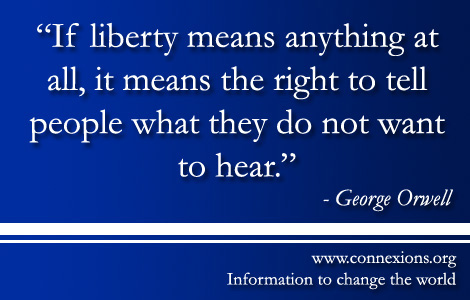 Disagreement is not hatred
Labelling ideas we disagree with as hatred serves only to shut down debate and prevents us from discussing important issues. All it does is cheapen the meaning of hatred, making life easier for the real bigots....  Class is more intersectional than intersectionality
An approach that leans toward greater emphasis on a class struggle focus is actually more intersectional than a focus which gives more attention to demographic-specific issues than to class ...  The problem with identity politics
Political strategies based on subjective experience will tend to reflect the broader prejudices or the political agendas of those people making the determinations, and to arbitrarily elevate certain experiences over others and reduce the complex reality of oppression to a mere stereotype.... |
 Calendar
 Twitter
 Facebook