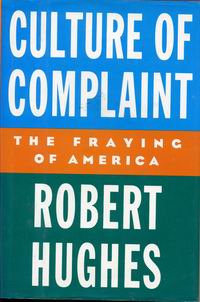
Culture of Complaint
The Fraying of America
Hughes, Robert
Publisher: Oxford University Press
Year Published: 1993
Pages: 210pp Price: $19.95 ISBN: 0-19-507676-1
Library of Congress Number: NX180.S6H85 Dewey: 700'.1'0309730904
Resource Type: Book
Cx Number: CX7002
Propaganda-talk, euphemism, and evasion are so much a part of American usage today that they cross all party lines and ideological divides. The art of not answering the question, of cloaking unpleasant realities in abstraction or sugar, is so perfectly endemic that we expect nothing else.
Abstract:
-
Table of Contents
Introduction
Lecture 1: Culture and the Broken Polity
Lecture 2: Multi-Culti and Its Discontents
Lecture 3: Moral in Itself: Art and the Therapeutic Fallacy
Notes
Excerpts:
Where would George Will, P.J. O'Rourke, the editors of the American Spectator and some of the contributors to the New Criterion all be without the inexhaustible flow of PC claptrap from the academic left? Did any nominally radical movement ever supply its foes with such a delicious array of targets for cheap shots.
And indeed there is a little sign of a repetition of what the senator from Wisconsin and his cronies actually did to academe in the 50s, usually through pressure on administrators and faculties who regarded themselves as liberal: the firings of tenured profs in mid-career, the inquisitions by the House Un-American Activities Committee on the content of libraries and courses, the campus loyalty oaths, the whole sordid atmosphere of persecution, betrayal and paranoia. The number of conservative academies fired by the left through police, by contrast is zero.
Geared to the students' limited experience of life and ideas as though this were some kind of educational absolute (whereas, of course, it is the thing that real education seeks to challenge and expand), mushy with superficial social-studies courses that inculcate only buzzwords and are designed, as far as possible, to avoid hard questions of historical context, it is short on analysis and critical scrutiny but long on attitude and feeling.
When feelings and attitudes are the main referents of argument, to attack any position is automatically to insult its holder, or even to assail his or her perceived "rights;" every argumentum becomes ad hominem, approaching the condition of harassment, if not quite rape.
The intellectual who imagines he or she can challenge the status quo by arguing the uselessness of language starts with not one, but three strikes against him, and this is why poststructuralism, though it has filled the seminar rooms for the last decade and given us a mound of largely unreadable cultural criticism along with some preachy neo-conceptual art, has had so little lasting effect on the way people in general, write, think or act. It is mostly an enclave of abstract complaint.
Radical academic and cultural conservative are now locked in a full-blown, mutually sustaining folie à deux, and the only person each dislikes more than the other is the one who tells both to lighten up. Such is the latest mutation of America's Puritan heritage.
Multiculturalism asserts that people with different roots can co-exist, that they can learn to read the image-banks of others, that they can and should look across the frontiers of race, language, gender and age without prejudice or illusion, and learn to think against the background of a hybridized society. It proposes - modestly enough - that some of the most interesting things in history and culture happen at the interface between cultures. It wants to study border situations, not only because they are fascinating in themselves, but because understanding them may bring with it a little hope for the world.
Separatism denies the value, even the possibility, of such a dialogue. It rejects exchange. It is multiculturalism gone sour, fermented by despair and resentment…
Artistic borrowing… leaves the lender no poorer, and draws attention to his riches, which can only be depleted by neglect and his loss of confidence in them; these cause them to be lost. Borrowing is an art of respect which may restore his respect for his goods, and help to preserve them. And he is at all times free to draw on them himself.
All too often, what poses as "radical multiculturalism" exists in an ignorance of other cultures as profound as that of a West Coast car-salesman newly appointed as the U.S. Ambassador to Somewherestan in the 60s.
The immense republic of literature contains everything - and its opposite. I have read a lot of books in the last forty-five years, since I became a conscious and addicted reader at the age of about nine. But when I try to imagine the number of books I have not read, and perhaps should have, and now probably never will, I feel giddy and ashamed.
"These clamorous dismissals and swooping assertions," Said writes, "are in fact caricatural reductions of what the great revisionary gestures of feminism, subaltern or black studies, and anti-imperialist resistance originally intended. For such gestures it was never a matter of replacing one set of authorities and dogmas with another, nor of substituting one center for another."
Some works of art have an overt political content; many carry subliminal political messages, embedded in their framework. But it is remarkably naïve to suppose that these messages exhaust the content of the art as art, or ultimately determine its value.
They are the result of a totalization of political influence, a belief - common to both left and right - that no sphere of public culture should be exempt from political pressure, since everything in it supposedly boils down to politics anyway. This is the outcome both of the PC belief that the personal is the political, acts of imagination not exempted, and of the conservative view that any stick that you can beat liberals with is a good stick, and never mind what else gets flattened in the struggle.
There are probably 200,000 artists in America, and assuming that each of them makes forty works a year that yields eight million objects, most of which don't have a ghost of a chance of survival. Maybe what we need is a revival of the WPA projects of the 1930s, not that there's the slightest likelihood of that. But certainly most of this surplus and homeless work isn't going to find a home in the museum.
More and more, it is assumed that one's cultural reach is fixed and determined forever by whatever slot one is raised in.
Subject Headings
