
|
|
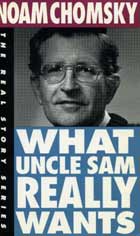
What Uncle Sam Really Wants
Chomsky, Noam
Publisher: Odonian Press/The Real Story Series, Berkeley CA 94707, USAYear Published: 1993 Pages: 112pp Price: $6.95 ISBN: 1-878825-01-1 Resource Type: Book Cx Number: CX6634 Chomsky discusses examples of U.S. intervention and links together events stretching over four decades in regions throughout the world. He provides a quick synopsis of American foreign policy and paints a vivid picture of the realities faced by social movements. Abstract: Noam Chomsky's What Uncle Sam Really Wants discusses American foreign policy since the end of the Second World War, highlighting the United States' use of subversion and force to maintain their economic and political hegemony over the Third World. At the end of World War II, the United States held roughly 50% of the world's wealth while only containing 6% of the total population. National Security Council planners aimed to maintain the discrepancy by any means necessary, most often by supporting violent regimes and dictatorships favoring the needs of American corporations and big businesses over social and political development. Discussing examples from Latin America, South East Asia, Africa, and the Middle East, Chomsky strings together decades of events revealing patterns and trends in American foreign involvement. The biggest fear of the United States, believes Chomsky, is the development of democratic governments in poor countries that threaten to produce positive social and political changes to improve the lives of their citizens. American foreign policy intended to ensure that profits flowed out of the countries they were exploiting for cheap labour, not find their way into social programs to help peasants and poor communities. When social movements began to spread in Third World countries, the United States subversively or openly worked to destroy the movements by imposing economic sanctions, funding guerilla movements and mass murderers or sending their own armed forces to tackle the problem as in Viet Nam and Panama, among several other examples. The fear of an example being set by a poor country for others to follow threatened to undermine America's capitalist methods of global governance. Chomsky discusses various examples of U.S. intervention and forms a narrative by linking together events stretching over four decades in regions throughout the world. His work provides a quick synopsis of American foreign policy and paints a vivid picture of the realities faced by social movements in Third World nations. What Uncle Sam Really Wants calls for Americans to pay greater attention to the role of their nation in global affairs and pressure their government to change its course of action through sustained, organized demonstration. "One of the things they want," Chomsky writes, "is a passive, quiescent population. So one of the things that you can do to make life uncomfortable for them is not to be passive and quiescent." [Abstract by William Stevenson] Table of Contents Editor's foreword The main goals of US foreign policy Protecting our turf The liberal extreme The "Grand Area" Restoring the traditional order Our commitment to democracy The threat of a good example The three-sided world Devastation abroad Our Good Neighbour policy The crucifixion of El Salvador Teaching Nicaragua a lesson Making Guatemala killing field The invasion of Panama Inoculating Southeast Asia The Gulf War The Iran/contra cover -up The prospects for Eastern Europe The world's rent-a-thug Brainwashing at home How the Cold War worked The war on (certain) drugs War is peace. Freedom is slavery. Ignorance is strength Socialism, real and fake The Media The Future Things have changed What you can do The struggle continues Political books by Noam Chomsky Notes Index Other Real Story Titles Subject Headings
|