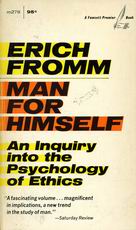
Man for Himself
An Inguiry into the Psychology of Ethics
Fromm, Erich
Publisher: Fawcett Premier Book, New York, USA
Year Published: 1969
Pages: 256pp Resource Type: Book
Cx Number: CX7503
Fromm reaffirms the validity of humanistic ethics, to show that our knowledge of human nature does not lead to ethical relativism but, on the contrary, to the conviction that the sources of norms for ethical conduct are to found found in human nature itself.
Abstract:
-
Table of Contents
Foreword
I. The Problem
II. Humanistic Ethics: The Applied Science of the Art of Living
1. Humanistic vs. Authoritarian Ethics
2. Subjectivistic vs. Objectivistic Ethics
3. The Science of Man
4. The Tradition of Humanistic Ethics
5. Ethics and Psychoanalysis
III. Human Nature and Character
1. The Human Situation
Man's Biological Weakness
The Existential and the Historical
Dichotomies in Man
2. Personality
Temperament
Character
The Dynamic Concept of Character
Types of Character: The Nonproductive Orientations
The Receptive Orientation
The Exploitative Orientation
The Hoarding Orientation
The Marketing Orientation
The Productive Orientation
General Characteristics
Productive Love and Thinking
Orientations in the Process of Socialization
Blends of Various Orientations
IV. Problems of Humanistic Ethics
1. Selfishness, Self-Love, and Self-Interest
2. Conscience, Man's Recall to Himself
Authoritarian Conscience
Humanistic Conscience
3. Pleasure and Happiness
Pleasure as a Criterion of Value
Types of Pleasure
The Problem of Means and Ends
4. Faith as a Character Trait
5. The Moral Powers in Man
Man, Good or Evil?
Repression vs. Productiveness
Character and Moral Judgement
6. Absolute vs. Relative, Universal vs. Socially Immanent Ethics
The Moral Problem of Today
Index
Excerpts:
... since man can't live without values and norms, relativism makes him a prey for irrational value systems.... to know what is good or bad for man one has to know the nature of man.
... rational authority has its source in competence .... the sources of irrational authority are power over people and fear on the part of those governed.... intense emotional pressure prevents children and adults from asking critically whether "good" in a judgment means good for him or for the authority.
... man can adapt himself even to unsatisfactory conditions, but in the process of adaptation he develops certain mental and emotional reactions .... he can adapt himself to almost any culture pattern, but in so far as these are contradictory to his nature he develops mental and emotional disturbances which force him eventually to change these conditions since he cannot change his nature.
... the split in man's nature leads to dichotomies called existential, because they are rooted in the very existence of man, they are contradictions which man cannot annul but to which he can react in various ways, relative to his character and his culture.... radically different from existential dichotomies are the many historical contradictions in the individual and social life which are not a necessary part of human existence but are man made and soluble, either at the time they occur or at a later period of human history.... man can react to historical contradictions by annulling them through his own action; but he cannot annul existential dichotomies, although he can react to them in different ways.
... the fact that the most members of a social class or culture share significant elements of character, and that one can speak of a social character representing the core of a character structure common to most people of a given culture, shows the degree to which character is formed by social and cultural patterns. But from the social character we must differentiate the individual character in which one person differs from another within the same culture.
... the difference between people is reduced to a common element, their price on the market. Their individuality, that which is peculiar and unique in them, is valueless and, in fact, a ballast.
Productiveness is man's ability to use his powers and to realize the potentialities inherent in him. If we say he must use his powers we imply that he must be free and not dependent on someone who controls his powers. We imply, furthermore, that he is guided by reason, since he can make use of his powers only if he knows what they are, how to use them, and what to use them for. Productiveness means that he experiences himself as the embodiment of his powers.
We are taught that to be selfish is sinful and that to love others is virtuous. To be sure, this doctrine is in flagrant contradictions to the practice of modern society, which hold the doctrine that the most powerful and legitimate drive in man is selfishness and that by following this imperative drive the individual makes his best contribution to the common good.
... the prime offence in the authoritarian situation is rebellion against the authority's rule. Obedience implies the recognition of the authority's superior power and wisdom; his right to command, to reward, and to punish according to his own fiats.... The authority may desire to give explanations for his commands and prohibitions, his rewards and punishments, or he may refrain from doing so; but never has the individual the right to question or to criticize. If there seem to be any reasons for criticizing the authority, it is the individual subject to the authority who must be at fault.
... irrational faith is the belief in a person, idea, or symbol which does not result from one's own experience of thought or feeling, but which is based on one's emotional submission to irrational authority.... irrational faith is the acceptance of something as true only because an authority or the majority say so, rational faith is rooted in an independent conviction based upon one's own productive observing and thinking.... faith and power are mutually exclusive.
the power to act creates a need to use this power and the failure to use it results in dysfunction and unhappiness.... to violate the forces directed toward life in any human being necessarily has repercussions on ourselves.
... differentiate between (1) suppression of the acting out of an evil impulse, (2) suppression of the awareness of the impulse, and (3) a constructive fight against the impulse.
Freud showed that the repressed impulse continues to operate and to exercise a profound influence upon the person although the person is not aware of it.
... by submitting to power, one loses potency.
Subject Headings
