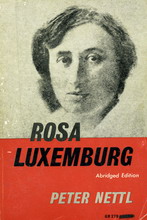
Rosa Luxemburg
Abridged Edition
Nettl, Peter
Publisher: Oxford
Year First Published: 1966
Year Published: 1969
Pages: 557pp Dewey: 335.43
Resource Type: Book
Cx Number: CX6544
A biography of Luxemburg by a British academic.
Abstract:
Excerpts:
[I]t is almost certainly true that more people at the time found their early way to revolutionary Marxism through Social Reform or Revolution and other writings of Rosa Luxemburg than through any other writer.... Nearly every dissident group from official Communism - German, French, or Russian - at once laid special and exclusive claim to the possession of Rosa Luxemburg's spirit.... The fiercer the Communist struggle against Luxemburgism, the greater the attachment to the revolutionary personality of Luxemburg, stripped of its errors.
She had neither the pioneering disdain for convention of an aristocrat nor the self-satisfaction and rather squat certainties of working-class realism; her sole demands were clarity and honesty of purpose, and a harmony of means.
Rosa Luxemburg was a particularly strong advocate of public frankness.... For her, the masses were ever-present spectators at the congress; they, more than anyone else, were the important judges of what was openly displayed before them and this, for Rosa and other radicals, was the main, the only reason for this display.
She had made her position clear from the start. Her sex was irrelevant; she indignantly refused the official suggestion that, like Clara Zetkin, she might find her natural habitat in the women's movement.
"Our task can only be made comprehensible [to the voters] by emphasizing the closest possible connection of capitalist society as a whole with the insoluble contradictions in which it is enmeshed and which must lead to the final explosion, a collapse at which we shall be both executioner and the executor who must liquidate bankrupt society."
As long as the situation of the oppressed class was a matter of formal law, such laws could presumably be changed - hence the partially legal character of all bourgeois revolutions. But wage slavery - the real basis of contemporary oppression - was not a matter of law at all.... The extra-legal nature of bourgeois domination was precisely the reason why revolution rather than reform was logically necessary.... Instead of basing herself on the somewhat formal idea that bourgeois society was as much expressed by its laws as any other and that revolution was necessary because a change of the law would be resisted, she introduced the novel idea that it was the particular feature of bourgeois society that its main engine of oppression was extra-legal - and therefore incapable of being changed by law, even if such a thing had been politically possible.
"On the one hand we have the mass; on the other we have its historical goal, located outside existing society. On the one hand we have the day-to-day struggle; on the other the social revolution... It follows that this movement can best be advanced by tacking betwixt and between the two dangers by which it is constantly being threatened. One is the loss of its mass character, the other the abandonment of its goal. One is the danger of sinking back to the condition of a sect, the other the danger of becoming a movement of bourgeois social reform."
Rosa Luxemburg had the reputation of drawing large crowds and always created an atmosphere of excitement and euphoria which was becoming the rare exception at party meetings. As a result she benefited from a curious political symmetry: as she lost her influence with the executive and the party leaders, she was more than ever in demand at the periphery of party life.
Like anti-Semitism, the inferior status of women was a social feature which would be eliminated only by the advent of Socialism; in the meantime there was no point in making any special issue of it. But disinterest in public did not mean private indifference. Since the break-up of her own 'marriage' to Leo Jogiches in 1907, Rosa had undertaken a campaign for the possession of the souls of her women friends, especially against those husbands who were also her political opponents. This subtle enticement had been carried out with Rosa's usual blend of intellect and emotion; a war on two fronts.
She was not writing for the Bolsheviks at all, but for the future, for German revolutionaries. In the last analysis the present was unimportant; present, past, and future had equal weight.
"Freedom only for the supporters of the government, only for the members of one party-however numerous they may be-is no freedom at all. Freedom is always and exclusively freedom for the one who thinks differently. Not because of any fanatical conception of 'justice' but because all that is instructive, wholesome and purifying in political freedom depends on this essential characteristic; and its effectiveness vanishes when 'freedom' becomes a special privilege."
Rosa Luxemburg, who did not mind in the last resort whether the Bolsheviks maintained themselves or not-and this perhaps was the major difference between her and them-was far more afraid of a deformed revolution than an unsuccessful one.
"The battle for Socialism can only be carried on by the masses, directly against capitalism, in every factory, by every proletarian against his particular employer... Socialism cannot be made and will not be made by order, not even by the best and most capable Socialist government. It must be made by the masses, through every proletarian individual. Precisely there where the proletarians are chained to capital, the chain must be broken. That is Socialism, only in this way can Socialism be created."
Subject Headings
