Connexions header
 

Other Voices: The Connexions Newsletter

August 25, 2025


This issue: In the heat of the summer

It’s hot. It’s really hot. It has been hot for days, and the heat and humidity aren’t going away. That’s true where I live, and it is true in many places around the world. Places that are traditionally hot are hotter than they have ever been. Places, like Newfoundland, in which long hot spells were a rarity, are now experiencing them with regularity. Forest fires are burning across the country. We’re breathing smoke.


I am sitting in my air-conditioned home, reading and writing. I often work from home, so when it is this hot, I mostly stay inside during the day, and only head out for walks early in the morning, and later in the evening. I am very aware of how lucky and privileged I am to have the luxury of living the way I do.


I just picked up Jane Jacobs’ 2004 book “Dark Age Ahead” (a great book which I highly recommend) and e-read the chapter in which she talks about the 1995 heat wave in Chicago. More than one thousand people in excess of the usual number for that period were admitted to hospitals because of heatstroke and other elated effects of the heat. Deaths in Chicago during that week were 739 in excess of a typical summer week. There were so many dead that a fleet of refrigerated trucks belonging to a local meat-packer was used to store the bodies, and even that proved not to be enough. Inevitably, those who died were predominantly poor and elderly. The chapter in Jacobs’ book in which she discusses these events is called “Science Abandoned.”


In the aftermath of these horrific events, as Jacobs relates, the U.S. Centers for Disease Control and Prevention (CDC) sent a large research team to Chicago to discover what went wrong and to identify ways of preventing future similar tragedies. The researchers paired each dead individual with someone who survived to see what differences could be identified.


Here is how Jane Jacobs sums up this massive research effort:

“This swift and Herculean effort by eighty researchers, their supervisors, and the high-powered designers of the study was worthless, because it turned up only what everybody already knew, including the meteorologists who had issued the early warnings [to use air conditioners, drink plenty of water, and seek cool places]. Those who died had run out of water, had no air-conditioning, did not leave their rooms to find cool refuge, and were not successfully checked up on. Indeed, the researchers’ finding were worse than useless. Survivors differed in having successfully kept cool. The findings were misleading because they encouraged blaming the victims: after all, they hadn’t looked after themselves.”


Jacobs contrasts the CDC’s approach with the approach taken by a single graduate student, Eric Klinenberg, working on his own, who noted that some districts of the city had considerably higher death rates than other districts, and asked why that was so. He looked at two adjacent districts, South Lawndale, where the death rate was fewer than 4 per 100,000, and adjacent North Lawndale, where the death rate was more than 10 times as high, 40 per 100,000. Klinenberg’s findings were subsequently published in “Heat Wave: A Social Autopsy of Disaster in Chicago.” South Lawndale, he found, was densely populated, with many stores and lots of street life. Old people were accustomed to walking outside, knew storekeepers, and had no hesitation about hanging around in their air-conditioned spaces, where they also had access to water. North Lawndale was much less densely populated. Much of the industry that had been located there had closed, their former presence marked by empty lots. Large numbers of residents had then moved out of the area, and as people left, stores closed and were boarded up, making the area unattractive to new immigrants to move to, and unattractive for walking. The remaining residents, predominantly old, had little reason to go outside because there was nowhere to go, tended to be afraid to leave their apartments, didn’t know their neighbours, and were often reluctant to answer the door if a stranger sent by the city came to check up on them.


And so many of them died, alone in their sweltering apartments, increasingly disoriented, and with no idea of what to do or who to call.


This is not just something that happened 30 years ago. It is the story of the present, and increasingly the future, in many cities in the world, as our planet heats up. Like COVID-19 and much else, extreme heat disproportionately affects the poor and the elderly. They are the ones who often don’t have air conditioning, and often they live alone with no support networks. Toronto, the city I live in, has some cooling centres, which is good, but you need Internet access to find out where they are, and hours and access are limited. Some older people are also reluctant, afraid, to leave their homes, for various reasons. An unknown number have died because of the heat. More will die, this year, and in the years to come, here, and in places that are even hotter than here.


I wish I had some simple solutions to offer, but I don’t.


Ulli Diemer



Featured Articles

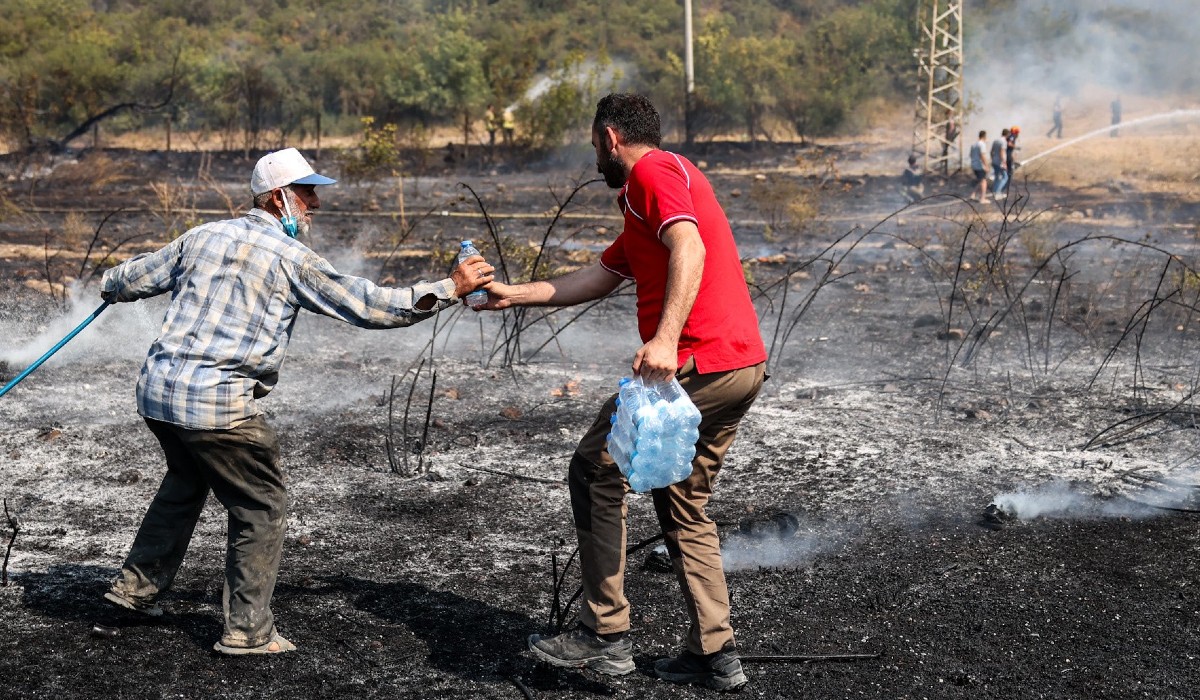
Canada's wildfires fuel the climate crisis

An appalling scramble by politicians to approve new fossil-fuel projects is happening just as
feedback effects from wildfires stoke climate catastrophe, says John Clarke. The same disregard
for climate consequences that has been shown in respect of previous fossil-fuel production and
its legacy, is readily apparent as the Canadian government and its provincial counterparts
prepare to dramatically increase oil and gas extraction and export in the period ahead. 

Read more

Keywords: Climate Change Denial - Forest Fires

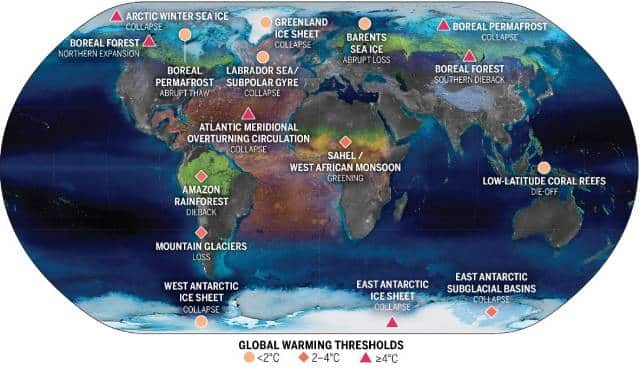
‘Climate tipping points pose catastrophic risks to billions of people’

Statement adopted by the Global Tipping Points Conference, June 30-July 3, 2025:
To trigger positive tipping points that help eliminate the 75% of greenhouse gas emissions linked
to the energy system, and transition away from fossil fuels in a just, orderly, and equitable
manner, we call on policymakers to adopt (and enforce) ambitious policy mandates to phase in
clean technologies and phase out fossil fuelled ones.

Read more

Keywords: Global Climate Change - Greenhouse Gas Emissions

'An Offer You Can’t Refuse': Trump Sends Canada a Wake-up Call

Sam Gindin says “Canadians understand full well that it is our sovereignty that is at stake. But we
differ on where this might take us. Talk of Canada becoming America’s 51st state is a red herring;
it is not Canada’s formal sovereignty that is in danger. What we confront is the drip-by-drip
erosion of our substantive sovereignty: the loss, already well under way, of democratic capacities
to determine the kind of society we hope to build.”

Read more

Keywords: Canada-U.S. Relations - Canadian Economy

Sanctions Are Just as Deadly as War

A Lancet study has found that the yearly total excess human death toll associated with economic
sanctions across the world is roughly equivalent to the annual human death tolls of active wars
and combat. In fact, the research reveals that on average, the civilian deaths caused by sanctions
exceed battle-related casualties in kinetic conflicts each year. According to the study, the worst effects on populations across various age groups are caused by unilateral US and EU sanctions
against targeted countries.

Read more

Keywords: Economic Warfare - War Crimes

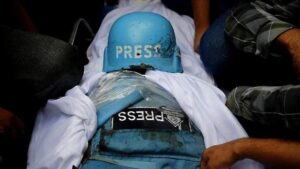
In Gaza, journalism comes with a death sentence

Israel has killed more journalists and media workers than were killed in both world wars plus the
wars in Vietnam, Yugoslavia, and Afghanistan.

Read more

Keywords: Violence against journalists - Israeli war crimes

'Israel Says' Is Not Journalism

Responsible journalists should explain to audiences that Israel has a long history of lying,
fabrication and deceit. Since the genocide began, there has been a litany of lies that the
‘mainstream’ media have propagated and, when exposed, ignored or downplayed.

Read more

Keywords: Media Bias - Propaganda


People's History

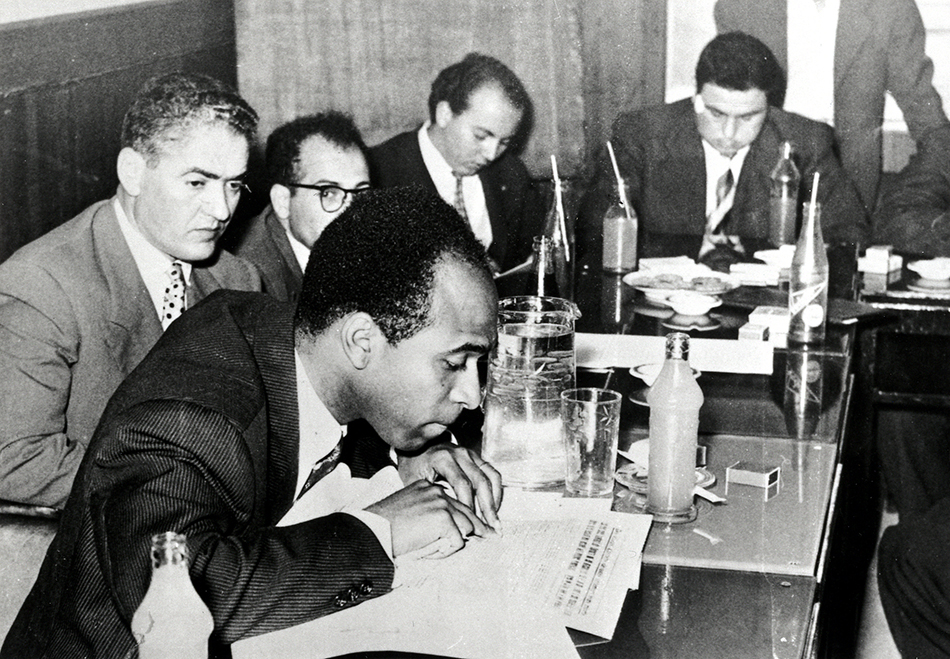
To Those Who Died So Young

The early deaths of Patrice Lumumba, Franz Fanon and other African revolutionary leaders
underline the brutality of imperialism. If a radical appears to lead a people to sovereignty, the
radical cannot be allowed to survive.

Find out more

Keywords: Anti-Colonialism - Colonialism


Quote of the Week

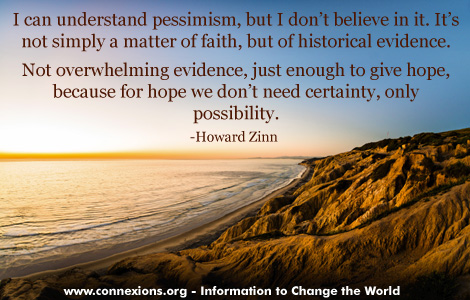
quote of the day
 

As always, we invite you to share this newsletter with your friends. You can forward this email, or send them the link to the Other Voices home page on the Connexions website at www.connexions.org/Media/CxNewsletter.htm. Please consider sharing it via social media


If you'd like to subscribe and receive this newsletter by email, please send an email to mailroom@connexions.org with ‘Subscribe’ in the subject line.

Your feedback is appreciated - and so are donations to keep us doing what we're doing!

Banner image reads: Support Connexions and help change the world!

Your support is needed to keep Connexions going

All of the work of the Connexions project is done by volunteers, but our expenses include rent, phone and computer costs and technical support, as well as expenses related to our ongoing project of converting printed archival materials into digital formats. You can make a one time or regular monthly contribution through the Donate page on the Connexions website.

Bequests

Many of us have made working for social justice a lifetime commitment. If you are thinking about leaving a legacy for social justice that will live on, you might want to consider leaving a bequest to Connexions in your will. If you'd like to discuss this option, please contact us via the contact info at the bottom of the page:

Follow us on Facebook or Twitter

Facebook Twitter

Copyright Connexions 2025. Contents are licensed under a Creative Commons Attribution Non-Commercial License. This means you are welcome to share and republish the contents of this newsletter as long as you credit Connexions, and as long as you don't charge for the content.


Issue edited by Ulli Diemer

Connexions Archive & Library


Email: mailroom@connexions.org


www.connexions.org

Enjoyed this issue of Other Voices? Want to introduce friends and family?
Then we encourage you to share this link.

Other Voices: The Connexions Newsletter, is always available online:
www.connexions.org/Media/CxNewsletter.htm