|
Thinking About Self-Determination By Ulli Diemer
A good place to start would be to ask whether that familiar canon of the left, "the right to self-determination", actually means anything, or whether it is another empty slogan whose main utility is that the left can repeat it like a mantra and so save itself the trouble of thinking critically. The traditional leftist position was well represented by Leo Panitch's
response to CD's editorial. Panitch's position boils down to three points: Panitch's position, broadly held on the left, will appeal to those who like simple answers to complicated questions. What he is really saying is that the left has nothing to contribute to the debate. There isn't the faintest trace of a socialist analysis here, nothing with which purveyors of the neo-conservative corporate agenda like the union-busting Jacques Parizeau or former Mulroney hatchet-man Lucien Bouchard would disagree. "Self-determination" is apparently exempt from class analysis, and evidently has nothing to do with changing who wields economic and political power, nothing to do with democratization, nothing to do with the struggle for socialism. What Panitch and his co-thinkers mean by "self-determination" is one thing only: secession. What they are saying to Quebec is: "You have the right to leave. Hurry up and go." It does not even occur to them that Quebecers might wish to choose an option other than secession. Panitch insists "we must work for the most amicable separation and the closest relationship ... if the right to self-determination gets exercised through a referendum." Is it not conceivable that if "the right to self-determination gets exercised through a referendum", Quebecers might very well vote to remain in Canada? Does Quebec maybe have the right NOT to secede? Apparently not. Panitch insists that English Canadian leftists must unequivocally advocate an independent Quebec, even though he must be well aware that a majority of Quebecers don't WANT an independent Quebec. The fact that opinion polls in Quebec show 30 per cent support for independence is as irrelevant to these defenders of "self-determination" as the inconvenient fact that Quebecers have exercised their "right to self-determination" through a referendum already. In that 1980 referendum, the PQ government concocted a deliberately fuzzy question designed to maximize the Yes vote by making it seem "sovereignty-association" could be attained without separation from Canada. Despite this ploy, 60 per cent of Quebecers exercised their "right to self-determination" by voting No. And despite that clear choice on the part of Quebecers, English-Canadian leftists by and large have continued to support Quebec independence, oblivious to how this contradicts their claim to support "self-determination". If "self-determination" for Quebec means secession from Canada even if a majority of Quebecers oppose it, for Native peoples, secession from Quebec is deemed unacceptable regardless of what Native peoples themselves may want. Denying that the Cree of Northern Quebec have a right to choose to remain part of Canada in the event that Quebec secedes, Panitch dismisses the wishes of Native peoples by portraying them as dupes of "federalists". For good measure, he wants us to keep quiet about the fact that some Quebec nationalists are racist in their attitudes to Native people, though he undoubtedly expects us to denounce racism anywhere else in Canada and indeed anywhere else in the world. The "right to self-determination" as promulgated by Panitch and much of the left is in fact nothing more than mindless cheerleading for bourgeois nationalism. By contrast, socialists like Karl Marx and Rosa Luxemburg argued that it was necessary to analyze the political, economic, and class content of nationalist movements on their individual merits, and support them only if they were progressive. Luxemburg argued that "the position of socialists with respect to nationality problems depends primarily on the concrete circumstances of each case, which differ significantly among countries, and also change in the course of time in each country." Therefore, she said, "the nationality question... cannot be settled by the use of some vague cliche, even such a fine-sounding formula as 'the right of all nations to self-determination'. For such a formula expresses either absolutely nothing, so that it is an empty, noncommittal phrase, or else it expresses the unconditional duty of socialists to support all national aspirations, in which case it is simply false." The kind of serious political analysis advocated by Marx and Luxemburg -- perhaps because it requires intellectual effort -- has become decidedly unpopular on the left, to be replaced by an uncritical acceptance of bourgeois concepts of nationality and the nation-state, devoid of class or socialist content. The accepted dogma now seems to be that each nationality and each ethnic and language group needs, and is entitled to, its own nation-state. In the real world, however, it is rarely possible to draw political boundaries that correspond with nationality. Nearly every nation-state and aspiring nation-state contains its own national minorities with conflicting nationalist claims on the same territory. These national groups are usually intermingled and intermarried, sharing the same physical territory, the same cities and towns, the same streets, the same bedrooms.. As a result -- except in those rare instances where a national group constitutes a homogeneous society united in its desire for national independence within uncontested borders -- "self-determination" for the majority frequently amounts to denying minorities their "right to self-determination". These minorities are then in turn confronted with the choice of losing their national and linguistic rights, or abandoning their ancestral homes in those human tragedies euphemistically known as "population transfers". Not surprisingly, violence is the rule rather than the exception in these situations. In Quebec, the desire for national independence has been, and continues to be, the goal of a minority. There is no chance it will win the support of an overwhelming majority in a referendum. Suppose, however, that in some future referendum 51% of the population, or even 55%, support independence. Does this mean that the 49%, or the 45%, who want to retain their Canadian nationality may therefore be legitimately deprived of their "right to self-determination"? If the people of the Eastern Townships, historically English-speaking, want their region to remain part of Canada, what justification is there for denying them this right? What is it about the theory of "self-determination" which would prevent Montreal from seceding from Quebec, if a majority of its population wished to do so? Confronted with such questions, the advocates of "self-determination" resort to evasion. "Are you prepared to endorse a challenge to Quebec's borders"? Panitch asks rhetorically, as if merely asking the question is enough to dismiss it as absurd. Apparently the "right to self-determination" applies only within Canada, not within Quebec, though why this is so, he does not explain. Like a religious dogma, the "right to self-determination" is not to be subjected to the inevitably embarrassing scrutiny of logical analysis, let alone class analysis. Like a routed army, battered by the defeats it has suffered in recent years, much of the left seems to be in wholesale retreat, indiscriminately abandoning not only the useless dogmas of Leninism and social democracy, but the principles and analytical tools it will need to re-group in the future. The results are depressing. A once solid independent socialist like Leo Panitch now asks CD to please explain "why class trumps nation as a value" and supports Mulroney's Charlottetown Accord, designed to give the bourgeoisie a political constitution irreversibly skewed to the requirements of the transnational corporations. The energies of much of the left are devoted to issuing appeals to the capitalist state to fix our problems, or to looking for ways to fix the state as if it had somehow accidently gone off track. The left has always been attracted to the state the way a moth is attracted to a flame, and the darker it gets, the more it is attracted to statist and nationalist illusions. The Quebec left has virtually abandoned a socialist agenda in its nationalist fixation, and not surprisingly has become as impotent and irrelevant as its English-Canadian counterpart. In both Quebec and English Canada the left uncritically supports Quebec independence even though it is glaringly obvious that the result would be increased control by transnational corporations and U.S. imperialism over both Quebec and the remainder of Canada, Quebec becoming a French-speaking neo-colony of the U.S. with less control over its destiny than it has now. The left will continue wallowing in this morass as long it is encumbered by its uncritical acceptance of the slogan "the right to self-determination". The hidden meaning, the real essence, of this slogan, is the belief that it is neither possible or desirable for two or more ethnic or language groups to live together in one country. I cannot imagine a more pessimistic and less socialist point of view. I would suggest a different perspective for the left, based on the following points: 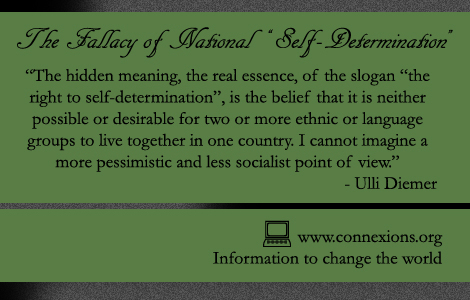 1. French-speaking Quebecois constitute a distinct nationality within Canada. Quebec is not an oppressed nation by any accepted definition of oppression. 2. English Canadian socialists should support Quebec's rights within Canada, including especially control over its own language, culture, education, and social development. 3. English Canadian socialists should oppose and combat all manifestations of English Canadian anti-Quebec chauvinism. 4. The break-up of Canada would be contrary to the interests of
working people in both English Canada and Quebec, and should be
opposed. Ulli Diemer
Aussi disponible en français: Réflections
sur l'autodétermination.
Subject Headings: Canadian Nationalism - Left, The - Nationalism - Quebec Partition - Quebec Separatism - Secession - Self-Determination - Separatism 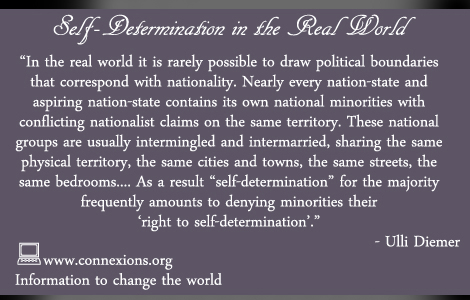 |
