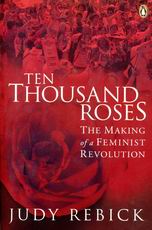
Ten Thousand Roses
The Making of a Feminist Revolution
Rebick, Judy
Publisher: Penguin
Year Published: 2005
Pages: 280pp Price: $24 ISBN: 0-14-301544-3
Library of Congress Number: HQ1453.R423 2005 Dewey: 305.42'0971'09045
Resource Type: Book
Cx Number: CX7165
Using interviews with many feminist activists, Rebick provides an oral history of feminism in Canada from the 1960s through the 1990s.
Abstract:
This book is a history of the feminist movement in Canada from 1960 to 2000 as told by the women who created and nurtured it. It is a book of narratives expressed by individual voices as well as groups of women in conversation.
Judy Rebick shows how though the timelines were the same, the Canadian movement was more interesting and effective. Canadian feminism was more diverse. Older, moderate, educated women worked alongside women who were in the working class as well as underclass. Women from different strata of Canadian society realized that though for example some came from union backgrounds and others from farms, they had common issues. This blending of classes and groups around women's issues happened nowhere else in the world.
Equal pay, matrimonial rights, abortion rights, gay rights, universal daycare and violence against women are the issues that drove the movement. Separate chapters are devoted to each and the book takes us through each issue from the viewpoints of the women participating . The same event is dealt with from the perspective of different participants and sometimes 'in conversation' with the women involved. These are conversations and reminiscences about how agendas were established and how things actually got done. For example, Laura Sabia talks about how in 1967, Lester Pearson, the then prime minister of Canada was threatened by her with a 2,000,000 woman march on Ottawa if he didn't authorize a Royal Commission on the Status of Women in Canada. He was hesitant to do it but acquiesced. She later admitted she was certain no more than ten women would have shown up for the march. But the bluff worked.
Rebick ends with how the movement faded in the mid 90's though there is still much to be done:
"The power of the women's movement has faded now, but the changes described in these pages affect the life of every woman and man in the country - in our work, our schools, our families, our friendships and our love relationships. Almost nothing is the same as when I was a girl. And these changes were brought about by thousands of women joining together to push down barriers and created new ways of being. Yet so much remains to be done to achieve the vision we had for an egalitarian world."
She feels that the slack is beginning to be taken up by a feisty group of third generation feminists who are reawakening the movement with humour and confidence.
[abstract by Esther Nash]
Table of Contents
Preface
Part I: The 1960's
1. The Seedbed
Part II: The 1970's
2. Speaking Truth to Power: The Status of Women Committees
3. The Women Are Coming: The Abortion Caravan
4. A Not-So-Quiet Revolution: The Quebec Women's Movement
5. Breaking New Ground: Organizing for Child Care
6. No Means No: Resistance to Male Violence
7. Solidarity and Sisterhood: Union Feminists
8. Coming Out: Lesbians Organize
9. Indian Rights for Indian Women: Changing the Indian Act
10. Taking It to the Streets: International Women's day
Part III: The 1980's
11. It's Not Just about Identity: Women of Colour Organize
12. Notwithstanding: Women and the Constitution
13. Freedom of Choice: The Morgentaler Clinics
14. Not a Love Story: The Pornography Wars
15. Federal Politics: NAC Becomes a Player
16. Closing the Wage Gap: Employment and Pay Equity
17. Ain't I a Woman? DAWN Canada
Part IV: The 1990's And Beyond
18. Reaction and Resistance: The Backlash
19. Sharing Power: Women of Colour Take the Lead
20. Women on the March: Fighting Poverty and Violence
Epilogue
Biographies
Acknowledgments
Photo Credits
Index
Subject Headings
