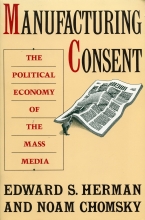
Manufacturing Consent
The Political Economy of the Mass Media
Herman, Edward S.; Chomsky, Noam
Publisher: Pantheon Books, New York, USA
Year Published: 1988
Pages: 414pp ISBN: 0-394-54926-0
Resource Type: Book
Cx Number: CX6137
Contrary to the usual image of the press and cantankerous, obstinate, and ubiquitious in its search for truth, Herman and Chomsky depict how an underlying elite consensus largely structures all facets of the news. They analyze how issues are framed and topics chosen, and the way in which the marketplace and the economics of publishing significantly shape the news.
Abstract:
In Manufacturing Consent, Chomsky and Herman argue that the mass media participate in providing the public with propaganda, contrary to the democratic notion that the media is professionally independent and committed to reporting the unbiased and objective truth. In reality, the media function to serve the interests and needs of powerful private firms and organizations of the state by adopting patterns of censorship and suppression campaigns under a "guided market system".Overall the book educates the reader about the level of propaganda existing in media forms, provides awareness about its consequences and teaches them ways to re-read the media so that they are not misinformed.
In pursuing these objectives, Herman and Chomsky carry out a free market analysis, which factors in market outcomes in examining the causes of biased choices and censorship practices in the media. Examples of such market forces include the tendency of media organizations to only hire right-minded employees; the self-censorship practised by journalists in order to meet economic needs and the internalizing of organizational constraints and policies by senior personnel. In addition to outlining the negative forces within the media, Herman and Chomsky also give credit to actors who attempt to positively shape the news and limit the irresponsibility of the media. Even when issues evoke controversy amongst the powerful, only a limited diversity of views will exist since challenges to fundamental premises are still excluded from the mass media.
In Chapter 1, Chomsky and Herman argue that the mass media are forced to use systemic propaganda in order to communicate with the people due to the factors of concentrated wealth and competing class interests. These factors in turn determine the methods used by the media to mobilize bias and the patterns seen in news broadcasting. In the remaining chapters, the authors test the validity of their "propaganda model" based on Whitman's "manufacture of consent" by applying it to the American media's performance in covering specific issues in the news. Chapter 2 demonstrates how the American media's political agenda defines subjugated peoples in enemy states as worthy victims, while categorizing victimized groups within the home nation as unworthy. Chapter 3 discusses the coverage of elections in Central America and demonstrates the power of the government to censor unfavorable facts from the public and manipulate media agendas. Chapter 4 shows how the American coverage of the Pope's shooting in Russia in 1981 exemplifies the "free-market disinformation" phenomenon. Chapter 5 evaluates the expectations of the propaganda model in understanding media portrayals of the US-Indochina wars. Finally, Chapter 6 illuminates how the media dragged Cambodia and Laos into the US attacks on Indochina.
[Abstract by Amanpreet Dhami]
Table of Contents
Preface
1 A Propaganda Model
2 Worthy and Unworthy Victims
3 Legitimizing versus Meaningless third World Elections: El Salvador, Guatemala, and Nicaragua
4 The KGB-Bulgarian Plot to Kill the Pope: Free-Market Disinformation as "News"
5 The Indochina Wars (I): Vietnam
6 The Indochina Wars (II): Laos and Cambodia
7 Conclusions
Appendix 1 The U.S. Official Observers in Guatemala, July 1-2, 1984
Appendix 2 Tagliabue's Finale on the Bulgarian Connection: A Case Study in Bias
Appendix 3 Braestrup's Big Story: Some "Freedom House Executives"
Notes
Index
Tables
1-1 Financial Data for Twenty-four Large Media Corporations (or Their Parent Firms), December 1986
1-2 Wealth of the Control Groups of Twenty-four Large Media Corporations (or Their Parent Companies), February, 1986
1-3 Affiliations of the Outside Directors of Ten Large Media Corporations (or Their Parents) in 1986
1-4 Experts on Terrorism and Defense on the "McNeil-Lehrer News Hour" January 14, 1985, to January 27, 1986
2-1 Mass-Media Coverage of Worthy and Unworthy Victims (1): A Murdered Polish Priest versus One Hundred Murdered Religious in Latin America
2-2 The Savageries Inflicted on Worthy and Unworthy Victims, as Depicted in the New York Times
2-3 Mass'Media Coverage Worthy and Unworthy Victims (2): A Murdered Polish Priest versus Two Hundred Murdered officials of the Guatemalan Mutual Support Group
3-1 Topics Included and Excluded in the New York Times's Coverage of the Salvadoran Election of March 25, 1984
3-2 Topics Included and Excluded in the New York Times's Coverage of the Nicaraguan Election Planned for November 4, 1984
3-3 Topics Included and Excluded in the New York Times's Coverage of the Nicaraguan Election of November 4, 1984
Subject Headings
